


01 / Context
A new city, an information gap
After moving to A Coruña, Spain, I wanted to become more connected to my new city. I was interested in local events, infrastructure projects, public announcements, and everything happening around me. But accessing that information wasn't particularly convenient. Most local news was published in Spanish across multiple websites, often cluttered with advertisements, cookie banners, and distracting content. Meanwhile, the local Russian-speaking community already had established communication channels, but no dedicated source bringing together relevant local news in Russian.
The opportunity: Make local news easier to discover, understand, and consume without requiring people to visit multiple websites.
02 / Discovery
Understanding the audience and the opportunity
Before building anything, I explored the existing information landscape. I looked at local news publishers, their RSS feeds, and the communication habits of Russian-speaking residents in A Coruña. Three observations shaped the product direction:
01 — Fragmented information
Relevant stories were distributed across different local publications, making it difficult to follow everything in one place.
02 — Language barriers
For newcomers who are still learning Spanish, reading local news requires additional effort.
03 — Existing distribution channels
The target community was already using messaging platforms, making Telegram a practical starting point without building a separate website or application.
The hypothesis
If local news could be automatically selected, translated, and delivered through a familiar platform, it would reduce the effort required to stay informed and attract an initial audience.
The goal wasn't to create another news website. It was to build a lightweight information product around an existing user behavior.
03 / Product Strategy
Start small. Automate everything possible.
I deliberately limited the scope of the first release. Rather than investing time in a custom interface, backend, or content management system, I focused on delivering the core value: relevant, readable local news.
The MVP needed to:
- Aggregate stories from multiple local publishers.
- Identify fresh and relevant content.
- Avoid publishing the same article repeatedly.
- Translate and summarize stories in Russian.
- Maintain a consistent editorial style.
- Publish automatically through Telegram.
This approach allowed me to validate the idea before investing in a more complex product.
04 / Solution & Architecture
An automated editorial pipeline
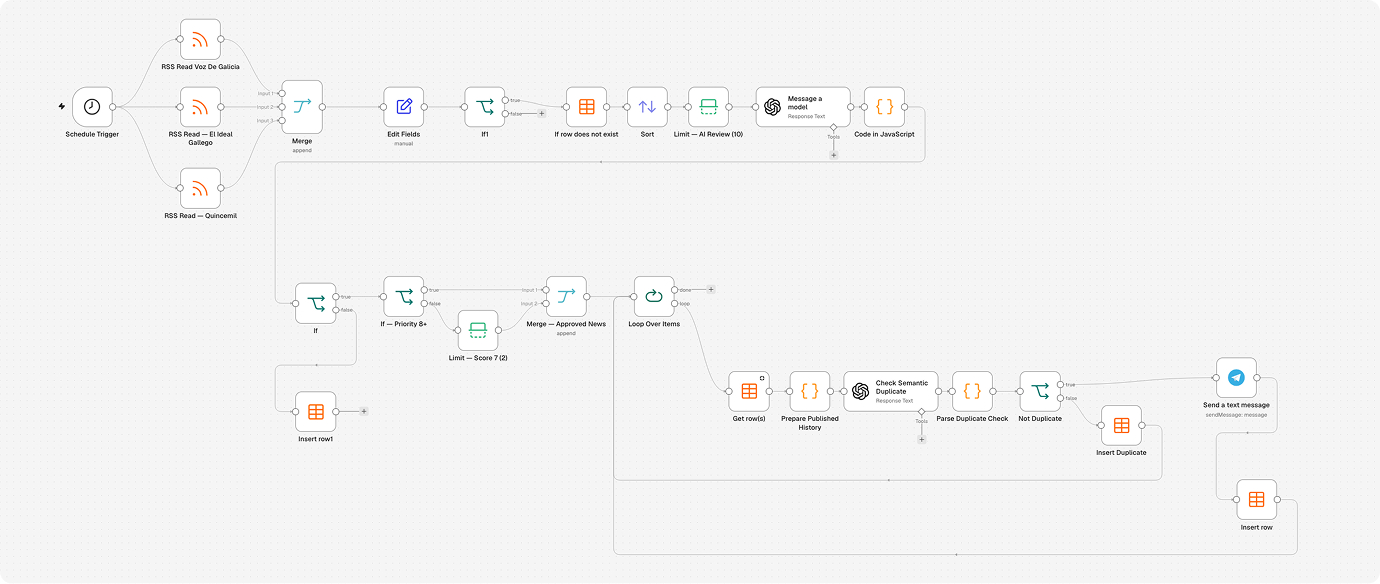
I used n8n as the orchestration layer, connecting news sources, OpenAI, custom JavaScript, data storage, and Telegram. The pipeline consists of five main stages.
01 / News Ingestion
Three RSS feeds provide a continuous stream of local news. Articles are filtered by publication date to prioritize recent stories.
02 / Deduplication
Previously processed URLs are checked against an n8n Data Table to prevent identical articles from being published repeatedly.
03 / AI Editorial Processing
GPT-4.1-mini analyzes the content, translates it into Russian, generates concise summaries, assigns categories, and evaluates relevance.
04 / Data Processing
Custom JavaScript nodes parse AI-generated responses, normalize structured data, and preserve article metadata.
05 / Publishing
Articles that meet the editorial relevance threshold are automatically published to the Telegram channel. The result is a lightweight publishing system that operates without a traditional CMS or custom backend.
05 / Design & Brand Identity
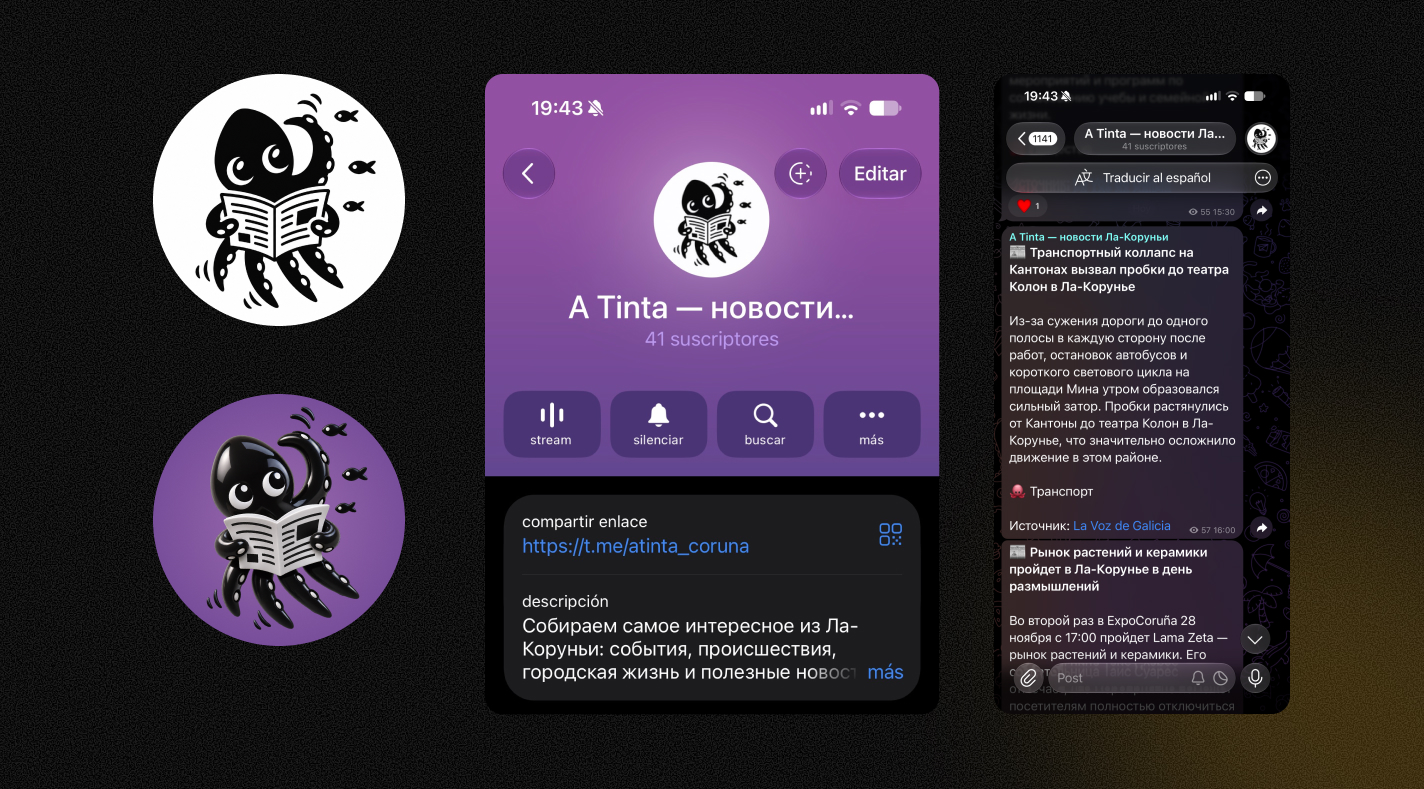
The Idea Behind A Tinta 🐙
The octopus is a nod to Galicia’s maritime culture and a symbol of the system’s multitasking capabilities. Just as an octopus uses its eight arms independently, A Tinta simultaneously collects, analyzes, and processes news from multiple local media sources. The name A Tinta connects two ideas: ink as the foundation of traditional journalism and the octopus as a symbol of intelligent, automated news aggregation.
06 / Challenges & Iteration
Automation was the easy part. Editorial judgment wasn't.
Connecting APIs and automating publishing was relatively straightforward. The more interesting challenges involved content quality and decision-making.
Duplicate Detection
Different publishers frequently cover the same event using different headlines and wording. URL-based deduplication prevents identical articles from appearing twice, but semantic deduplication is needed to recognize overlapping stories across sources.
News Relevance
The system must select useful stories from hundreds of headlines across three RSS feeds. I introduced an AI-based scoring mechanism to prioritize relevant local information and filter out low-value content.
Editorial Policy
AI-generated translations need to preserve factual meaning, avoid unsupported assumptions, and maintain a consistent editorial voice. This required iterating on prompts and establishing clearer content guidelines.
Data Reliability
AI responses aren't always perfectly structured. Custom JavaScript handles inconsistent formatting and helps keep the publishing pipeline stable. These challenges reinforced an important lesson: reliable automation requires much more than connecting services.
07 / Launch & Early Results
From prototype to real users
After two evenings of development, A Tinta was ready to launch. I introduced the channel to the local Russian-speaking community and shared it through an existing community chat.
42 subscribers joined during the first 24 hours.
For a hyperlocal product targeting a relatively small audience, this was an encouraging first signal of interest. The MVP also demonstrated that the complete publishing process could operate automatically, from collecting articles to delivering finished posts. However, initial subscriptions alone don't validate long-term product value. The next step is understanding whether readers continue engaging with the content over time.

08 / Next Steps
Moving from automation to a better editorial product
The next development priorities focus on improving content quality and measuring user engagement.
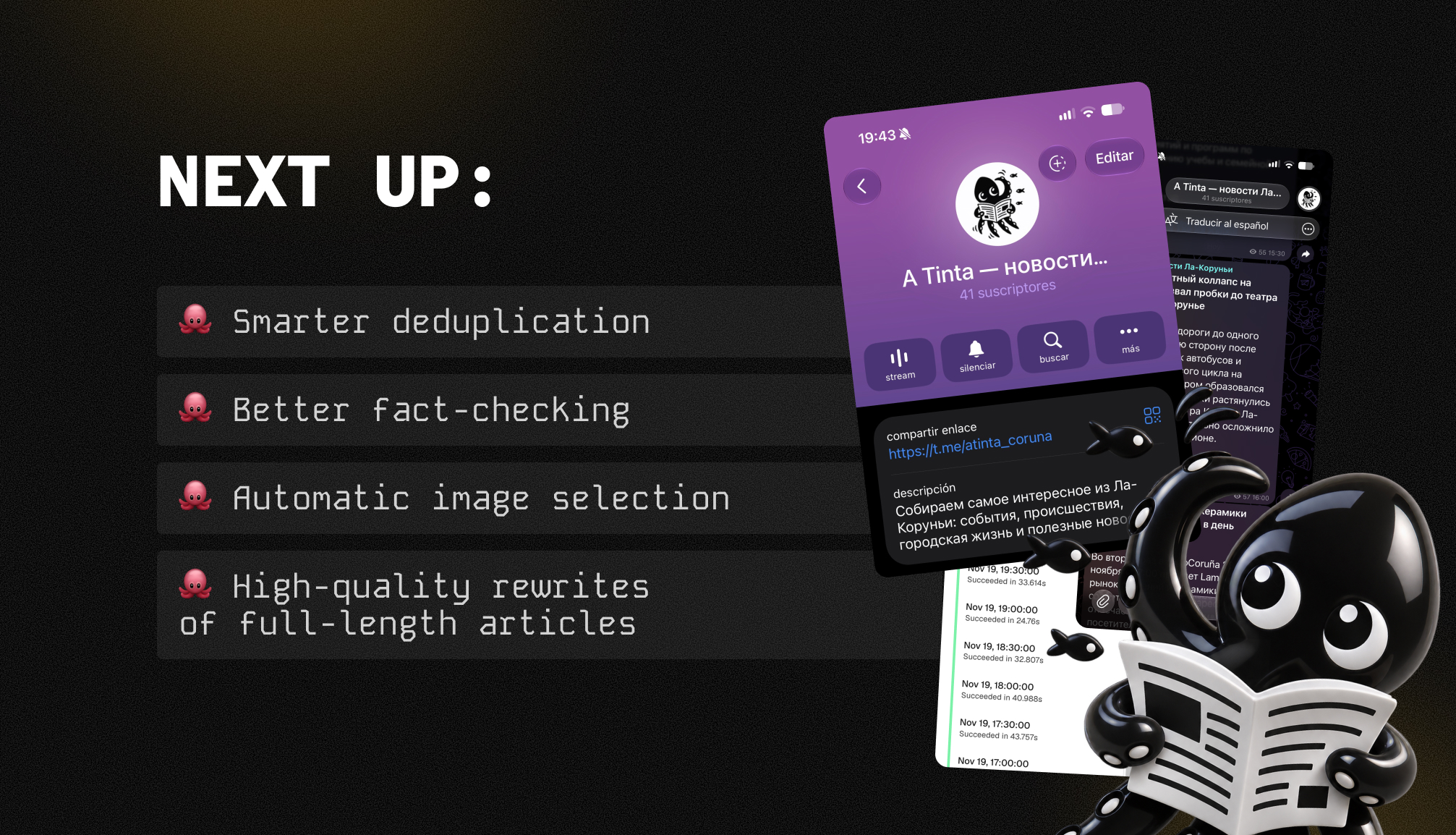
Semantic Deduplication
Identify when different sources report the same event, even with completely different headlines.
Editorial Accuracy
Improve translation quality, source fidelity, and consistency of AI-generated content.
Content Enrichment
Automatically select relevant article images and improve post presentation.
Full-Article Rewriting
Explore high-quality rewrites of longer articles while preserving factual accuracy and respecting source rights.
Product Analytics
Track subscriber growth, post views, engagement, and content preferences to guide future improvements.
09 / Takeaways
Product thinking matters more than the tools
A Tinta started as a personal inconvenience and became a working digital product in two evenings. The project brought together several disciplines I enjoy working across: product discovery, brand identity, automation, JavaScript, AI integration, and growth. It also demonstrated how quickly modern tools can reduce the distance between identifying a problem and putting a solution in front of real users. But the biggest lesson wasn't about speed.
Building an MVP is easier than ever. Building something genuinely useful still requires understanding the audience, making thoughtful product decisions, and continuously improving the experience.